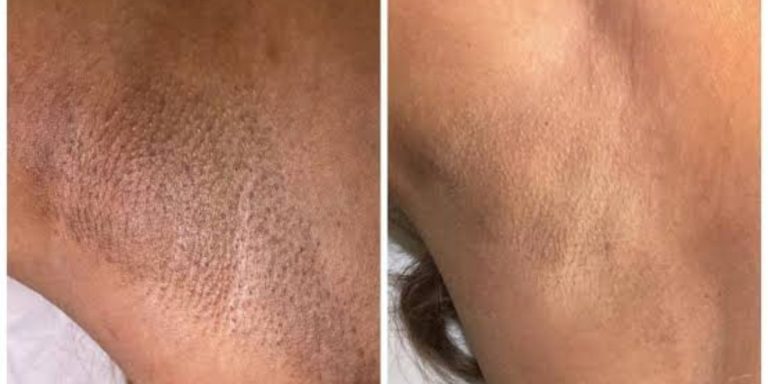
Two things are almost universally true when people research laser hair removal. First, they have read or heard that it is painless, usually from a clinic trying to reassure them. Second, they have read or heard that it is excruciating, usually from someone describing an older device or a particularly sensitive zone. Neither description is accurate, and neither helps a real person make a real decision.
The honest answer sits in the middle: you will feel something, it will not last, and it will get less intense with every session you complete. What exactly you feel, how intense it is, and which zones are more or less comfortable depends on biology that is worth understanding before you book.
This guide explains the sensation accurately, breaks down why different body areas rate differently, covers what FDA-cleared Splendor X technology does specifically to improve comfort, and gives you practical steps to make every session easier. All laser hair removal at BlueDivine Aesthetics in Buckhead, Atlanta uses Splendor X with individualized settings for all skin tones.
What Does Laser Hair Removal Actually Feel Like?
The most common description you will find is a rubber band snapping against the skin. That is accurate but incomplete. Here is a more precise account.
When the laser fires, it emits a pulse of concentrated light energy lasting only milliseconds. That energy is absorbed by melanin in the hair follicle and converts to heat. The heat is what you feel: a brief, localized warmth that arrives and disappears in less time than a blink. The sensation does not build, does not linger, and does not throb afterward. Each pulse is its own discrete moment of sensation followed immediately by nothing.
The word ‘laser’ carries psychological weight that tends to inflate anticipation beyond what the treatment actually delivers. Patients who have spent weeks dreading an appointment often sit up after the first few pulses and say the same thing: that it was less than expected. The anticipation is typically worse than the treatment.
The correct word for what most patients experience is discomfort rather than pain. Pain implies something sustained, building, or difficult to tolerate. Discomfort is brief, manageable, and does not prevent normal activity before or after the session. Some zones are more uncomfortable than others, and the first session is always the most intense. Both of those things change as treatment progresses.
Why Does Pain Vary So Much From Person to Person and Zone to Zone?
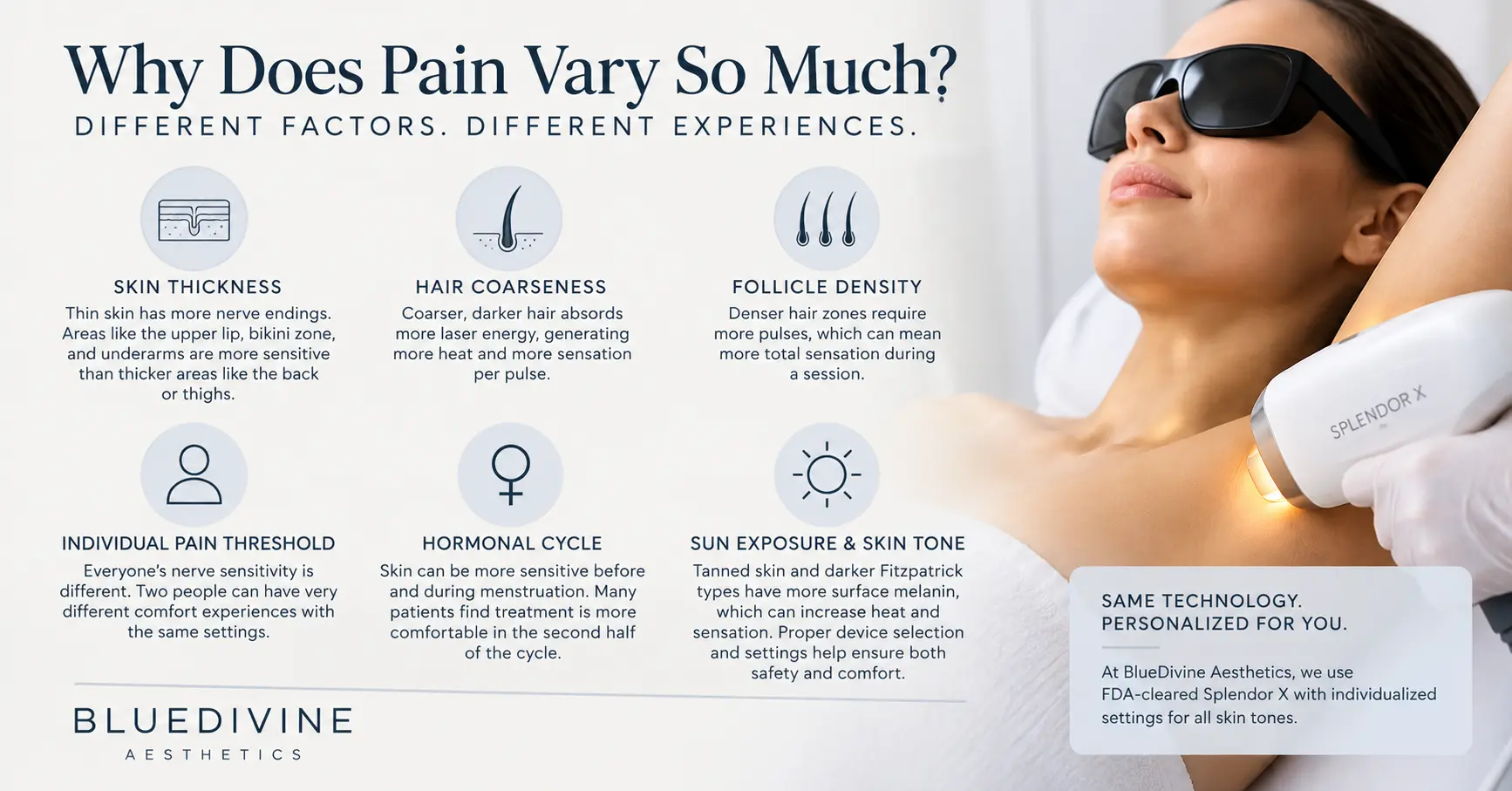
The variation in how patients experience laser hair removal is not random. It follows predictable biological patterns, and understanding those patterns helps set accurate expectations before any session.
Skin thickness is the most important factor. Thin skin contains more nerve endings per unit of surface area than thick skin. The upper lip, the inner bikini zone, and the underarms have among the thinnest skin on the body. The back, upper thighs, and shoulders have among the thickest. This anatomical difference directly explains why the Brazilian zone consistently rates higher than the back even when the same device, settings, and patient are involved.
Hair coarseness and melanin concentration in the follicle determines how much energy is absorbed per pulse. Coarser, darker hair absorbs more laser energy. More absorption means more heat generated per follicle. More heat means more sensation at the treatment site. A patient with very coarse, dark hair in the upper lip will feel more per pulse than a patient with finer hair in the same zone, even with identical energy settings.
Follicle density matters too. Denser hair zones require more pulses per area to achieve full coverage. More pulses means more total sensation events per session, even if each individual pulse is mild.
Individual pain threshold varies genuinely between people. This is not a matter of attitude or willpower. People have measurably different baseline nerve sensitivity, and two patients with identical hair, skin, and treatment areas can have different comfort experiences at the same settings.
Hormonal cycle timing affects skin sensitivity. Skin tends to be more reactive in the days before and during menstruation due to changes in estrogen and progesterone levels. Scheduling treatment in the second half of the cycle, when sensitivity tends to be lower, is a practical strategy for patients treating sensitive zones.
Sun exposure and skin tone affect how much surface heat is generated per pulse. Tanned skin and naturally darker Fitzpatrick types have more melanin in the epidermis. Surface melanin absorbs some laser energy before it reaches the follicle. That surface absorption generates heat at the skin level, which increases the sensation. This is one of the reasons appropriate device selection and energy calibration for skin tone matters not only for safety but for comfort.
How Painful Is Laser Hair Removal by Body Area? Zone-by-Zone Ratings
The ratings below reflect typical patient experience using Splendor X with appropriate cooling and individualized settings. Individual variation applies. A 10 represents the most intense discomfort imaginable; most patients describe laser treatment across all zones as between 3 and 7, never at the extreme end of the scale.
Laser Hair Removal Pain Ratings by Body Zone
| Body Zone | Estimated Pain Rating (1 to 10) | Why This Zone Rates Here |
| Brazilian / Inner Zones | 7 to 8 | Thinnest skin on the body in this area, highest nerve density, often coarser hair, most inflammatory response per pulse |
| Upper Lip | 6 to 7 | Thinnest facial skin, very high nerve density, hair often coarse and hormonally influenced |
| Chin | 5 to 6 | Thin skin, frequently coarse hormonal hair with high melanin absorption per follicle |
| Underarms | 5 to 6 | Thin skin, coarse hair, sensitive zone with high follicle density |
| Bikini Line | 5 to 7 | Sensitive outer groin skin, coarser hair than legs, more nerve-dense than the back or chest |
| Full Face | 4 to 5 | Varies by sub-zone; cheeks lower, upper lip higher; overall moderate due to varied skin thickness |
| Chest | 4 to 5 | Moderate skin thickness; sternal area can be more sensitive than the sides |
| Lower Legs | 3 to 5 | Moderate skin thickness; shin area slightly more sensitive than calf |
| Upper Legs | 3 to 4 | Thicker skin, lower nerve density per square centimeter than bikini or facial zones |
| Back | 3 to 4 | Among the thickest skin on the body, lower nerve density; large area but low per-pulse sensation |
| Shoulders | 3 to 4 | Similar to upper back; thick skin, moderate hair density, manageable sensation for most patients |
These ratings assume appropriate technology and individualized settings. IPL devices and older single-wavelength lasers without adequate cooling will rate higher across all zones because the surface heat management is less effective. The ratings above reflect what patients can realistically expect with Splendor X’s dual cooling system at BlueDivine Aesthetics.
| BLUEDIVINE AESTHETICS
The upper lip and Brazilian zones are the two areas patients most frequently ask about before their first session, and they are also the two zones where the gap between expectation and experience tends to be smallest: patients who expect these to be intense are usually correct. What surprises most patients is that these zones become notably more comfortable by sessions 3 and 4 as hair density and coarseness reduces. At BlueDivine Aesthetics, topical numbing cream is available and most commonly applied in the upper lip and inner bikini zones for first and second sessions, particularly for patients with a lower baseline pain tolerance or coarser hair in those areas. |
Why Does Laser Hair Removal Hurt Less With Every Session?
This is the part of the story that most articles mention but few explain, and it matters because it is one of the strongest reasons to complete the full treatment series rather than stopping after one or two sessions.
Each session targets follicles that are in their active hair growth phase. When a follicle is successfully treated, it produces finer, thinner, lighter hair in subsequent cycles rather than the original coarse, dark hair. Finer hair contains less melanin in the follicle. Less melanin means less laser energy is absorbed per pulse. Less energy absorbed means less heat generated. Less heat generated means less sensation per pulse at that follicle location.
The effect compounds progressively. After session 1, a portion of the treated follicles begin producing finer hair. After session 2, more follicles join that group. By sessions 4 and 5, a substantial portion of the treated area is producing hair thin enough that the laser has far less to absorb at each location. Many patients describe session 5 or 6 as feeling dramatically different from session 1 in the same zone, even though the device and settings have not fundamentally changed.
There is a second mechanism: total follicle count decreases over the series. Fewer active follicles means fewer pulses required per session. Fewer pulses means less total discomfort per appointment, independent of the per-pulse intensity reduction described above.
The practical implication: if a patient experiences significant discomfort in session 1 and decides to stop, they walk away with partial results and the most uncomfortable experience already behind them. The remaining sessions in the series would have been progressively easier. This is the strongest argument for completing the recommended treatment plan rather than abandoning it after early sessions.
How Does Splendor X Reduce Discomfort Compared to Older Laser Devices?
Every laser hair removal provider describes their device as comfortable. Very few explain what specifically makes one device more comfortable than another. Here is the specific difference with Splendor X.
Splendor X uses a dual cooling system with two simultaneous mechanisms. Cryo-Touch is a cooled handpiece tip that maintains contact with the skin surface before, during, and after each pulse. It creates a layer of surface cooling that protects the epidermis from the heat generated during energy delivery. Cryo-Air delivers a stream of cold air precisely over the treatment area during each pulse, removing heat from the skin surface in real time as the laser fires.
The key distinction from older devices is timing. Many older laser systems applied cooling before the pulse or after the pulse but not effectively during it. The heat generated during the pulse itself had less active management. Splendor X’s dual cooling operates simultaneously with the laser pulse, which means surface heat is being removed at the same moment it is being generated. This reduces the peak surface temperature during treatment and is the primary reason patients describe Splendor X sessions as more comfortable than sessions on older diode or IPL systems.
The square spot technology is a secondary comfort factor. Round laser spots create uneven energy distribution at their edges, with some overlap between adjacent pulses if the handpiece is moved slightly. These overlapping areas receive more cumulative energy than intended, which can produce localized hot spots. A square spot tiles uniformly without edge overlap. More consistent energy distribution across the treatment area means no areas of concentrated heat from uneven pulse placement.
The 1064nm Nd:YAG wavelength in the BLEND X system provides an additional comfort benefit specifically for medium to darker skin tones. The 1064nm wavelength is absorbed less strongly by epidermal melanin than shorter wavelengths. This means less energy is absorbed at the skin surface and more reaches the follicle at depth. Less surface absorption means less surface heat, which is one reason the BLEND X approach is more comfortable for darker Fitzpatrick types than Alexandrite-only or IPL systems. According to FDA clearance documentation, both the Alexandrite 755nm and Nd:YAG 1064nm wavelengths are cleared for laser hair reduction, supporting the safety and efficacy of this dual-wavelength approach.
When Should You Use Numbing Cream for Laser Hair Removal?
Topical numbing cream, typically containing lidocaine or a similar anesthetic, reduces skin sensitivity for approximately 45 to 60 minutes after application. It is appropriate in specific situations and unnecessary in others.
Numbing cream is most useful for the upper lip, inner bikini and Brazilian zones, and underarms in the first one to two sessions, particularly for patients with lower pain tolerance or coarser hair in those zones. These are the areas where the per-pulse sensation is highest and where numbing cream produces the clearest comfort benefit.
It is generally not needed for the back, chest, upper legs, or shoulders, where the per-pulse sensation is mild for most patients. Using numbing cream in these lower-sensitivity zones is not harmful, but it adds 45 to 60 minutes of preparation time without meaningful benefit for the majority of patients in those areas.
One practical nuance: topical numbing cream slightly affects skin surface properties. At BlueDivine Aesthetics, if you plan to use numbing cream, discuss this with your provider at or before booking so they can account for it in their assessment. Applying it at home before arriving typically works well and allows you to arrive ready for the session without added waiting time at the clinic.
What Can You Do to Make Each Laser Session More Comfortable?
The steps below are grounded in the biology of why laser discomfort occurs. Each one has a specific mechanism, not just a general guideline.
Pre and Post Session Comfort Guide
| Action | Why It Helps |
| Shave 24 to 48 hours before your session | Removes surface hair that absorbs energy before it reaches the follicle. Less surface heat means less sensation at the skin surface. |
| Avoid caffeine before sensitive zone sessions | Caffeine increases skin sensitivity and can heighten the perception of discomfort, particularly in the upper lip, bikini, and Brazilian zones. |
| Schedule away from your menstrual cycle | Skin sensitivity increases in the days before and during menstruation due to hormonal changes. Scheduling in the second half of your cycle reduces this. |
| Avoid sun exposure for 2 to 4 weeks before treatment | Tanned or recently sun-exposed skin contains more surface melanin, which absorbs more laser energy at the epidermis and increases the heat sensation per pulse. |
| Stay hydrated | Dehydrated skin is measurably more sensitive to thermal stimuli. Well-hydrated skin generally responds better and with less discomfort during laser treatment. |
| Communicate with your provider during the session | Energy settings can be adjusted in real time if discomfort is higher than expected. You should always tell your provider if something feels too intense. |
| Apply a cool compress immediately after | Gentle cooling of the treated area in the 15 to 30 minutes following treatment reduces residual warmth and helps skin settle faster. |
According to the American Society of Plastic Surgeons, laser hair removal is consistently among the most performed non-surgical aesthetic procedures nationally. The established patient satisfaction with this treatment reflects both the efficacy and the manageable comfort experience when performed with appropriate technology and provider expertise.
Pros and Cons of Laser Hair Removal Comfort
| Pros | Cons / Honest Limitations |
| Each session becomes progressively more comfortable. As treated follicles produce finer hair with less melanin, there is less energy absorbed per pulse and less heat generated in subsequent sessions. | Session 1 is the most uncomfortable. Patients who base their entire expectation on the first session often assume every session will feel the same, which is not accurate. It improves significantly. |
| Splendor X’s dual cooling (Cryo-Touch contact cooling and Cryo-Air cold air delivery) is designed to reduce surface heat in real time during each pulse, making treatment notably more comfortable than older generation devices. | Sensitive zones such as the upper lip, Brazilian, and underarms will always involve more discomfort than the legs or back, regardless of device quality or cooling system. Zone anatomy drives this. |
| Topical numbing cream is available at BlueDivine for patients treating sensitive zones or experiencing higher-than-expected discomfort in early sessions, providing additional comfort management. | Numbing cream requires 30 to 60 minutes of application time before the session. Patients who want to use it need to plan around this and ideally apply it at home before arriving or arrive early. |
| The discomfort lasts only a fraction of a second per pulse. There is no lingering throb, no recovery time for pain, and no sustained discomfort after the session ends for most patients in most zones. | Individual pain tolerance varies meaningfully between patients. Two patients treating the same zone with the same device at the same settings can have genuinely different comfort experiences. |
Frequently Asked Questions
Does laser hair removal hurt more than waxing?
For most patients in most zones, laser hair removal is less painful than waxing the same area. Waxing removes hair by force from the root across a larger area simultaneously, producing a sustained pulling pain followed by inflammation. Laser treatment delivers brief millisecond pulses with no tearing or pulling. The upper lip and Brazilian zones during session 1 can feel comparable to waxing in intensity, but the sensation is shorter per event and does not involve the surface trauma that waxing causes. Laser also gets progressively more comfortable with each session; waxing does not.
Which body area hurts the most during laser hair removal?
The Brazilian and inner bikini zones consistently rate highest in discomfort because the skin in this area is the thinnest on the body with the highest nerve density per square centimeter. The upper lip is the second most commonly reported sensitive zone due to thin facial skin and high nerve density. The back, upper legs, and shoulders consistently rate lowest because the skin is thicker and the nerve density per square centimeter is lower. Pain ratings follow skin thickness and nerve density more reliably than any other factor.
Does laser hair removal hurt more on darker skin tones?
With an appropriate device, it does not need to. Older IPL and Alexandrite-only devices carry more surface heat risk for darker skin tones because the epidermis absorbs more energy at shorter wavelengths, which can increase the sensation. Splendor X’s BLEND X system adjusts the ratio toward more 1064nm Nd:YAG for darker skin tones. The 1064nm wavelength is absorbed less strongly by surface melanin, which means less surface heat and a more comfortable experience for medium to darker Fitzpatrick types. At BlueDivine Aesthetics, all skin tones are treated with individualized BLEND X settings.
Can I use numbing cream before laser hair removal?
Yes. Topical numbing cream is available at BlueDivine Aesthetics and is most commonly recommended for the upper lip, inner bikini, Brazilian, and underarm zones, particularly in the first one to two sessions. It should be applied 45 to 60 minutes before the session. If you plan to use it, let your provider know when booking so they can account for it in your appointment. Numbing cream is generally not needed for the back, legs, or other lower-sensitivity zones.
Why does laser hair removal hurt less after a few sessions?
Each session treats active follicles, which then produce finer, thinner hair in subsequent cycles. Finer hair contains less melanin, which means less laser energy is absorbed per pulse and less heat is generated per follicle. Fewer active follicles also means fewer total pulses per session. By sessions 4 and 5, most patients describe the treated area as notably more comfortable than during session 1, even though the device and energy settings have not fundamentally changed. This progressive improvement is a direct result of the treatment working as intended.
Does Splendor X hurt less than other laser devices?
Most patients find Splendor X more comfortable than older single-wavelength or IPL systems. The dual cooling system, combining Cryo-Touch contact cooling and Cryo-Air cold air delivery simultaneously during each pulse, removes surface heat in real time rather than before or after. The square spot technology delivers more uniform energy without the overlapping hot spots created by round-spot devices. For darker skin tones, the BLEND X ratio toward more 1064nm wavelength further reduces surface heat. These are specific design factors that contribute to a more comfortable experience compared to older generation devices.
Laser Hair Removal at BlueDivine Aesthetics in Atlanta
BlueDivine Aesthetics at 107 West Paces Ferry Road in Buckhead has offered laser hair removal for over 13 years using Splendor X dual-wavelength technology with Cryo-Touch and Cryo-Air dual cooling. Every session begins with a pre-treatment skin assessment to confirm appropriate BLEND X settings for each patient’s skin tone and hair characteristics.
Topical numbing cream is available for sensitive zones. All Fitzpatrick skin types are treated at the same pricing with no surcharge. Cherry Financing is available for all series packages. A complimentary consultation is available for patients who want to discuss expectations, comfort concerns, or treatment areas before their first session.
Ready to start your laser hair removal series at BlueDivine?
View packages and book directly at BlueDivine’s Zenoti booking page. BlueDivine Aesthetics, 107 West Paces Ferry Road, Buckhead, Atlanta GA 30305. Phone: (404) 467-4232.